Rate Field, Chicago (Veeck, As in SPECtacular)
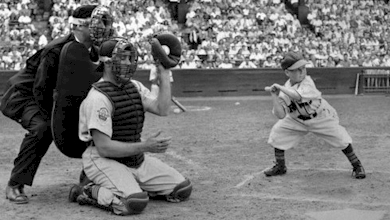
By Associated Press or ACME Newspictures or team photographer - The Philadelphia Inquirer, Public Domain, https://en.wikipedia.org/w/index.php?curid=4443428
I find it impossible to go to a White Sox game in Rate Field, with the “exploding scoreboard” and memories of the out-of-control “Disco Demolition Night,” without thinking about Bill Veeck, one of my absolute favorite characters in the history of baseball. “Character” is completely appropriate for Veeck. He owned three major league teams, one of them (the White Sox) twice, and made a play for ownership of at least three others, and did something memorable everywhere it went, even if it was just having the shortest player in major league history (see photo above, story below).
In 1962, between his two stints owning the White Sox, he published an autobiography titled Veeck – As in Wreck, a play on his difficult-to-pronounce last name. Bill Veeck was innovative, original, outspoken, hated by his fellow owners (he was reportedly the last major league owner not to have an independent individual fortune) – what’s not to like.
Personally, if I wrote a biography of Veeck, I’d want to call it Veeck – As in SPECtacular.
If you want a more detailed history of Bill Veeck, you can read the Wikipedia article I linked, or read his autobiography, but here are some of my favorite things about Bill Veeck.
Veeck and Integration
Veeck claimed that in the fall of 1942, while he owned a minor league team, he tried to buy the moribund Philadelphia Phillies, and stock the team with Negro League stars. There is no independent verification of this, and the sale didn’t happen, but it’s plausible, and is a topic that baseball historians argue over. If he had done this, four years before Jackie Robinson, the Phillies would have become an instant power.
The reason it’s plausible is because in 1946, he bought the moribund Cleveland Indians, and a few months after Jackie Robinson became the first Black to play in the majors in the 20th Century, Veeck signed Larry Doby, who became the first Black to play in the American League. The next year, he signed the legendary Satchel Paige.
Veeck didn’t want Doby to have to play in Spring Training in Florida, so he convinced Horace Stoneham, owner of the New York Giants, to join the Indians in moving their Spring Training sites to Arizona, the start of the Cactus League, where about half the teams now have their spring training. Incidentally, the Indians trained in Tucson, starting a Spring Training tradition in our home town that lasted 60 years, and which, in its final years, saw Kerry working with the Colorado Rockies.
Veeck and the Browns (and the shortest player in baseball history)
After the 1949 season, Veeck sold the Indians to pay for a divorce, but by 1951, he bought the moribund St. Louis Browns.
He tried various ploys to make the Browns more successful financially. He upped the rent on the Browns’ tenant at the stadium, the more successful and more popular Cardinals. When the Cardinals’ owner was convicted of income tax evasion, it looked as though Veeck might have caught a break, but then brewery magnate Augie Busch bought the Cardinals. Veeck tried to move the Browns to Milwaukee, but was blocked by the Boston Braves, who owned the rights to Milwaukee because they had a minor league team there (the Braves then moved to Milwaukee). So he sold the Browns to a group from Baltimore, who moved the team there.
It was with the Browns that he had what is my favorite among many memorable exploit. One Sunday, in the second game of what looked to be a meaningless late-season doubleheader, he brought in Eddie Gaedel, a novelty performer who was 3 feet 7 inches tall, to pinch hit in the first inning. Not surprisingly, Gaedel walked on four pitches, trotted to first and was replaced by a pinch runner, never to be seen near the major leagues again. But the image of Gaedel at the plate (at the top of this blog) is iconic. There’s one other aspect of the story that appeals to me. When Gaedel came out to pinch-hit, the opposing manager protested, but Veeck’s manager produced a copy of Gaedel’s contract, as well as the paperwork that Veeck had submitted on Friday night, after league offices were closed, to put Gaedel on the official roster. In other words, it was all legal, although the rules were changed the next day so that someone had to actually look at, and approve, roster changes. Veeck loved tweaking the establishment.
Veeck and the White Sox (and Disco Demolition)
Before the 1959 season, he bought the White Sox. Unlike every other team he bought, the White Sox were not moribund, since they had a nucleus of players good enough that they had finished in the top half of the American League every year since 1951. But they hadn’t won the league championship since 1919, and their attendance was miserable.

They promptly made it to the World Series in 1959, set an all-time team attendance record in 1959 and broke it in 1960. During this stretch, he introduced baseball’s first “exploding scoreboard,” which would have fireworks that would go off when a hometown player hit a home run, and flash "HOME RUN" in a state-of-the-art 1960 font. That was so popular that when the new stadium (now Rate Field) was built 30 years later, they constructed a scoreboard with that feature, which we saw in action this game. Veeck sold the team for health reasons in 1961.
Veeck again owned the White Sox for five more seasons, starting in 1976. In 1977, they broke the 1960 team attendance record. His teams never finished higher than third, but his promotions were as memorable as always. At one point, he had the team wearing short pants (the players were not amused). At another point, he convinced announcer Harry Caray to lead the singing of “Take Me Out to the Ballgame,” a tradition that became associated with the Chicago Cubs when Caray moved across town. But Veeck’s 1970s tenure is best known for a July 1979 promotion that went awry.
Trying to cash in on the backlash to the rise of disco music, the White Sox had “Disco Demolition Night.” They discounted admission for fans who brought in a disco record and turned it in to be destroyed in an explosion between games of a double-header. They expected a bigger-than-normal crowd for a weekday evening, and they got more than twice as many people as they expected. In fact, they sold out the stadium, and people kept coming, most with record albums, some of which were contributed to the pile to be destroyed, some of which were thrown around the stadium like frisbees. Given the larger than expected number of record albums, the destruction explosion ended up being larger than intended, and damaged the field, although the fans who stormed the field and started a riot (finally quelled by riot police) after the explosion may have caused more damage. The umpires postponed the second game, but the next day, the league office ruled that the White Sox had to forfeit the game.
Some other things about Veeck
Veeck's first job in baseball was with the Chicago Cubs, a decade or two before he became a team owner. He started by doing things like selling concessions, ended as team treasurer. Along the way, in 1937, he came up with an idea to make Wrigley Field look distinctive, and to protect the outfielders -- plant ivy on the outfield walls.
At least three other times, Veeck tried to buy a team, but the major league owners blocked him, because he so relished being a thorn in their sides.
Oh, and just for good measure, he had a wooden leg, which was sometimes used as an ashtray, sometimes as a prop when he thought someone was “asking for an arm and a leg” in negotiations, and once as part of a costume when he marched in a Bicentennial parade as the fifer with a wooden leg.
Success on the field and at the box office
Bill Veeck was definitely entertaining, perhaps the greatest showman in baseball ever. But he was more than that.
Since 1920, the Cleveland Indians/Guardians have won the World Series once, in 1948, in the middle of Veeck’s four years running the team. In that same stretch, the White Sox have played in the World Series twice, once while Veeck owned the team. Only the Browns didn’t win while Veeck was in charge, but they never won.
In 1948, the Indians smashed their all-time attendance record, and didn’t draw as many fans again for 47 years. The White Sox set all-time attendance records in 1959 and 1960, and the 1960 record wasn’t broken for 17 years, when Veeck again owned the team. His 1952 St. Louis Browns had the second-highest season attendance of any Browns team, second by less than 100 fans per game.
It’s hard not to like Bill Veeck, and when you look in detail, it’s hard not to admire him.
The game: Chicago White Sox 5, Los Angeles Angels 2
The White Sox didn't use the exploding scoreboard last night after home runs, fearing that some of the canine attendees would not appreciate the fireworks. That was thoughtful of them. Tonight, I got three chances to get a picture of it in its full glory.
The Angels starting pitcher, José Soriano, was off to a phenomenal start, having given up only one run total in six starts. He gave up his second of the year on a home run by Colson Montgomery in the 2nd, his 3rd and 4th on a two-run home run by Drew Romo in the 4th, and the Angels never really got close after that. Romo added another home run in the 6th.


Comments
Post a Comment